
Today we will discuss modern day heresies by explaining ways the ancient church fathers combatted the same heresies. To combat gnostic and heretical views in the early church, church fathers such as Saint Irenaeus, Saint Jerome, and Origen wrote books entitled “Against Heresies,” “Against Helvidius,” “Against the Pelagians,” and “Against Celsus.” Numerous church councils further came together to refute heresies. Sadly, many of these heresies haven’t died out, as witnessed by the presence of Mormons and Scientologists who deny the divinity of Christ, Jehovah’s Witnesses who believe Jesus was God the Father’s first creation, and Calvinists like John MacArthur who disparage the Blessed Virgin Mary. Today, we’ll focus on the latter since John MacArthur’s notions go far beyond being merely disturbing.
In a video with the caption, “Mary Mother of God?” and other related videos, John MacArthur questioned Mary as Mother of God. Mary is the God-bearer, or “theotokos,” who conceived and gave birth to Jesus, as affirmed at the Council of Ephesus. Mary gave birth to Jesus. Jesus is God. Therefore, Mary is the mother of God. Denying Mary as the bearer of Jesus leads to very poor Christology, as pointed out by Catholics such as Trent Horn.
In the gospel of Luke, Elizabeth clearly recognized Mary as the mother of God when her cousin Mary visited her. Luke 1:41-45: “And when Elizabeth heard the greeting of Mary, the baby leaped in her womb. And Elizabeth was filled with the Holy Spirit, and she exclaimed with a loud cry, “Blessed are you among women, and blessed is the fruit of your womb! And why is this granted to me that the mother of my Lord should come to me? For behold, when the sound of your greeting came to my ears, the baby in my womb leaped for joy. And blessed is she who believed that there would be a fulfillment of what was spoken to her from the Lord.”
This statement mirrored that of King David, who when brought the ark exclaimed in 2 Samuel 6:9, “How can the ark of the Lord come to me?” “And David danced before the Lord with all his might (2 Samuel 6:14). The ark of the covenant was so holy that one could die from merely touching it.
John MacArthur claimed that Catholic reverence to Mary is equivalent to reverence to Ishtar, the Assyrian and Babylonian goddess and “queen of heaven” in Jeremiah 7:18 and Jeremiah 44:17-25. Catholics do not link Mary to this pagan goddess of the Old Testament. Rather, we refer to the end of Revelation 11 and beginning of Revelation12 for our beliefs about the Blessed Virgin Mary:
Revelation 11:19: “Then God’s temple in heaven was opened, and the ark of his covenant was seen within his temple. There were flashes of lightning, rumblings,[a] peals of thunder, an earthquake, and heavy hail.”
Revelation 12:1-6: “And a great sign appeared in heaven: a woman clothed with the sun, with the moon under her feet, and on her head a crown of twelve stars. She was pregnant and was crying out in birth pains and the agony of giving birth. And another sign appeared in heaven: behold, a great red dragon, with seven heads and ten horns, and on his heads seven diadems. His tail swept down a third of the stars of heaven and cast them to the earth. And the dragon stood before the woman who was about to give birth, so that when she bore her child he might devour it. She gave birth to a male child, one who is to rule all the nations with a rod of iron, but her child was caught up to God and to his throne, and the woman fled into the wilderness, where she has a place prepared by God, in which she is to be nourished for 1,260 days.”
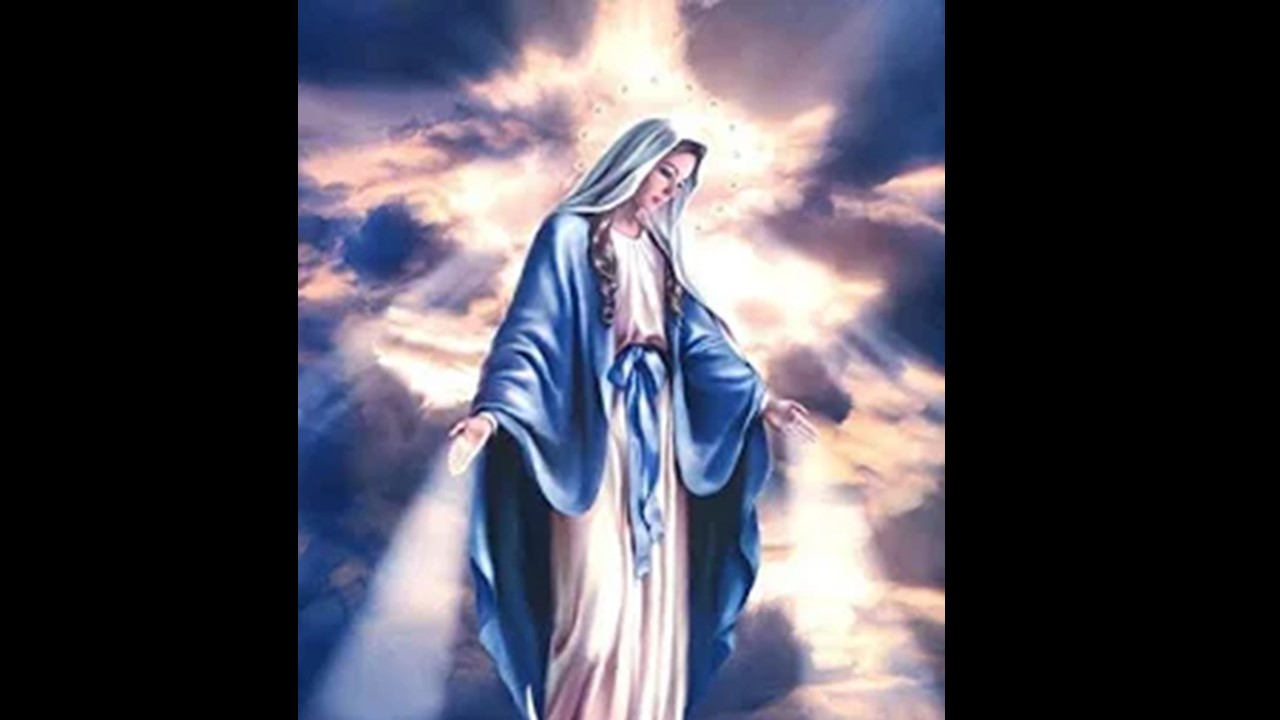
Mary is the ark of the new covenant, the new Eve, who was crowned in heaven as the queen mother of the ruler of the world, Jesus Christ. In the 2nd century, Justin Martyr and Irenaeus called Mary the new Eve since she defeated the ancient serpent of Genesis 3:15 by giving birth to the Christ, the ruler of the world.
John MacArthur claimed that Mary’s duties to Jesus had been fulfilled when she and Joseph discovered the 12-year-old Jesus at the Temple – and that Jesus’ reference to Mary as “woman” at the Wedding of Cana and at the foot of the cross was a way of equalizing her to other women. His evidence for his claim included references Luke 11:27-28 and Matthew 12:46-50.
Luke 11:27-28 states: “As he said these things, a woman in the crowd raised her voice and said to him, ‘Blessed is the womb that bore you, and the breasts at which you nursed!’ But he said, ‘Blessed rather are those who hear the word of God and keep it!’
Matthew 12:46-50 states: “While he was still speaking to the people, behold, his mother and his brothers stood outside, asking to speak to him. But he replied to the man who told him, ‘Who is my mother, and who are my brothers?’And stretching out his hand toward his disciples, he said, ‘Here are my mother and my brothers! For whoever does the will of my Father in heaven is my brother and sister and mother.’”
When one considers this passage in the context of Mary’s Magnificat, it’s obvious that she is exactly the one who heard the word of God and kept it and who has always done the will of the Father in heaven.
And Mary said, “Behold, I am the servant of the Lord; let it be to me according to your word.” (Luke 1:38)
Mary’s Magnificat is precisely how a perfectly obedient, noble, and blessed woman responded to the angel Gabriel and God: “And Mary said, “My soul magnifies the Lord, and my spirit rejoices in God my Savior, for he has looked on the humble estate of his servant. For behold, from now on all generations will call me blessed; for he who is mighty has done great things for me, and holy is his name. And his mercy is for those who fear him from generation to generation. He has shown strength with his arm; he has scattered the proud in the thoughts of their hearts; he has brought down the mighty from their thrones and exalted those of humble estate; he has filled the hungry with good things, and the rich he has sent away empty. He has helped his servant Israel, in remembrance of his mercy, as he spoke to our fathers, to Abraham and to his offspring forever.” (Luke 1:46-48)
In the 4th century, Epiphanius addressed two heresies about the blessed virgin Mary in his book entitled Panarion. He condemned collyridianism, which is the worship of Mary as a goddess, and antidicomarianitism, which disputed Mary’s virgin virtues by claiming she had sexual relations with Joseph after the birth of Jesus.
Catholics believe in four Marian dogmas: Mary was immaculately conceived free from the stain of original sin; Mary is a perpetual virgin; Mary is the mother of God; and Mary was assumed into heaven, body and soul.
Saint Jerome also addressed the heresy against Mary’s virginity in “Against Helvidius” in 383.
“I was requested by certain of the brethren not long ago to reply to a pamphlet written by one Helvidius. I have deferred doing so, not because it is a difficult matter to maintain the truth and refute an ignorant boor who has scarce known the first glimmer of learning, but because I was afraid my reply might make him appear worth defeating….The axe of the Gospel must therefore be now laid to the root of the barren tree, and both it and its fruitless foliage cast into the fire, so that Helvidius who has never learned to speak, may at length learn to hold his tongue.”
“I must call upon the Holy Spirit to express His meaning by my mouth and defend the virginity of the Blessed Mary. I must call upon the Lord Jesus to guard the sacred lodging of the womb in which He abode for ten months from all suspicion of sexual intercourse. And I must also entreat God the Father to show that the mother of His Son, who was a mother before she was a bride, continued a Virgin after her son was born. We have no desire to career over the fields of eloquence, we do not resort to the snares of the logicians or the thickets of Aristotle. We shall adduce the actual words of Scripture. Let him be refuted by the same proofs which he employed against us, so that he may see that it was possible for him to read what is written, and yet to be unable to discern the established conclusion of a sound faith.”
Jerome pointed to Mary’s bewilderment when told by the angel Gabriel that she would conceive and bear a son since she had taken a vow of perpetual virginity. “How can this be since I know not man?” She was betrothed to Joseph, which in ancient times was a commitment greater than mere engagement. Had she not taken the vow, she would have known how it could be. Furthermore, it is likely that God asked Mary to take this vow; hence, her bewilderment. She was entirely obedient to God.
Jerome pointed to numerous church fathers who affirmed Mary’s perpetual virginity, such as Ignatius, Polycarp, Justin Martyr, and Irenaeus. Saint Ignatius of Antioch was martyred around 107. He knew the apostle John and wrote to and received correspondence from Mary.
Jerome also pointed out how the reference to Jesus as the “first born” didn’t mean he had brothers or sisters as he still would have been first born without brothers or sisters. He further explained how Jesus’ brothers James, Joseph, Judas, and Simon were cousins and the first two were named as sons of the “other Mary” at the foot of the cross, the wife of Clopas/Alphaeus and sister of the blessed virgin Mary.
In his book “Church Histories,” Eusebius referenced writings in the 2nd century by Hegesippus to state that Clopas/Alphaeus was a brother of Joseph, Jesus’ legal father. Taken together, two brothers could have married two sisters.
Jerome further pointed out how the many brothers and sisters were not named when Joseph, Mary, and Jesus fled to Egypt following Jesus’ birth, nor were they named when Joseph and Mary found Jesus at the Temple. Since it’s likely that Joseph had passed before Jesus’ ministry, it’s unlikely that they bore this multitude of four sons and two or more daughters in the time after the finding at the Temple and Jesus’ ministry when he was around thirty years old.
In conclusion, Catholics affirm the beliefs of early church fathers and saints concerning the blessed virgin Mary as being a perpetual virgin and the mother of God. Believing otherwise is and has always been heretical.
SJ Thomason is a Christian wife and mother of two sons. She works as an associate dean and professor of business management at a medium-sized university in the United States. In 2022, she reverted to Catholicism from Protestantism (Lutheran and Baptist), which was the church in which she was raised and educated. After reading numerous books and articles by ancient church fathers, she found she had no choice. She affirms all beliefs in the Catholic catechism.
 Christian Apologist